



Ramadan Kareem! Here, you will find all Ramadan-related resources from the our Islamic Center, including iftar timings, upcoming events, and important policies and announcements from the administration. If you have any questions.

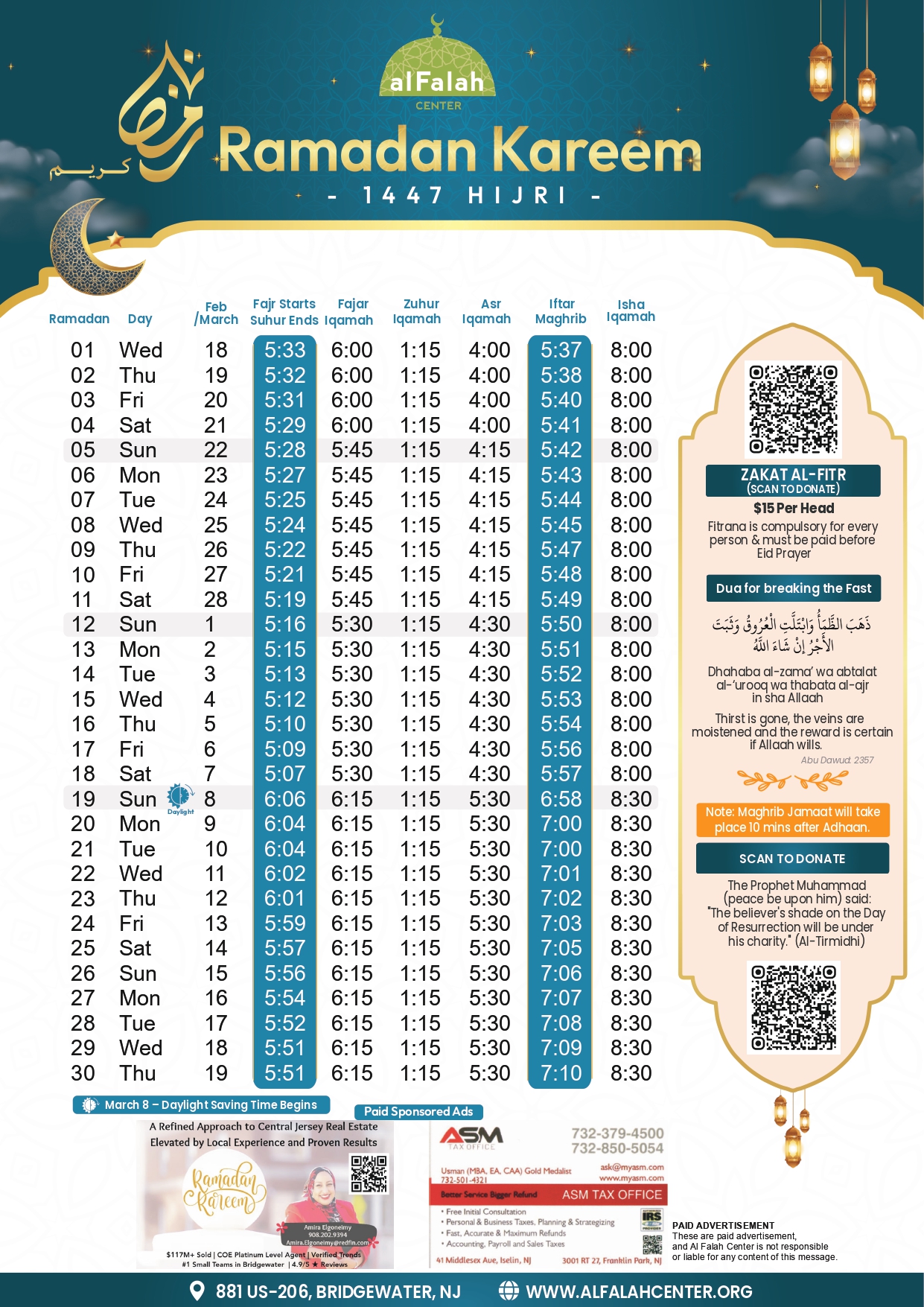
Sahoor & Iftar Timetable 2026
| # | Date | Sahoor | Iftar | Taraweeh |
|---|
| # | Date | Sahoor | Iftar |
|---|
Hadith on Fasting: Help break fast, earn same reward:
Zayd ibn Khalid reported: The Messenger of Allah, peace and blessings be upon him, said, “Whoever helps break the fast of a fasting person, he will have the same reward as him without decreasing anything from the reward of the fasting person.”
Source: Sunan al-Tirmidhī 807
The Messenger of Allah said: “Whoever builds a mosque for the sake of Allah, like a sparrow’s nest for Allah or even smaller, Allah will build for him a house in Paradise.”
Sunan Ibn Majah 738
The Zakat-ul-Fitr amount for this year is $15 per family member. Zakat-ul-Fitr is obligatory and must be paid before Eid Salah. Click the link below to be directed to the Zakat donation page.
This day signifies the end of fasting and serves as a time for reflection, gratitude, and community bonding.
Narrated by Anas bin Malik: The Prophet Muhammad (peace be upon him) said:
“Allah has given you better than those feasts (festivals of non-believers): the Eid-ul-Adha and Eid-ul-Fitr.
Sign-up for volunteer slots during Ramadan – earn volunteer
hours and ajar! View available slots at the link below.
Ramadan is the ninth month of the Islamic calendar, which follows the lunar system. As a natural phenomenon, lunar months vary in length, containing either 29 or 30 days. This means that the lunar year is 10 or 11 days shorter than the solar year, since months in the solar year often have 31 days. Ultimately, this means that those measuring against the solar calendar will perceive Ramadan as “shifting” a few days earlier each Gregorian year.
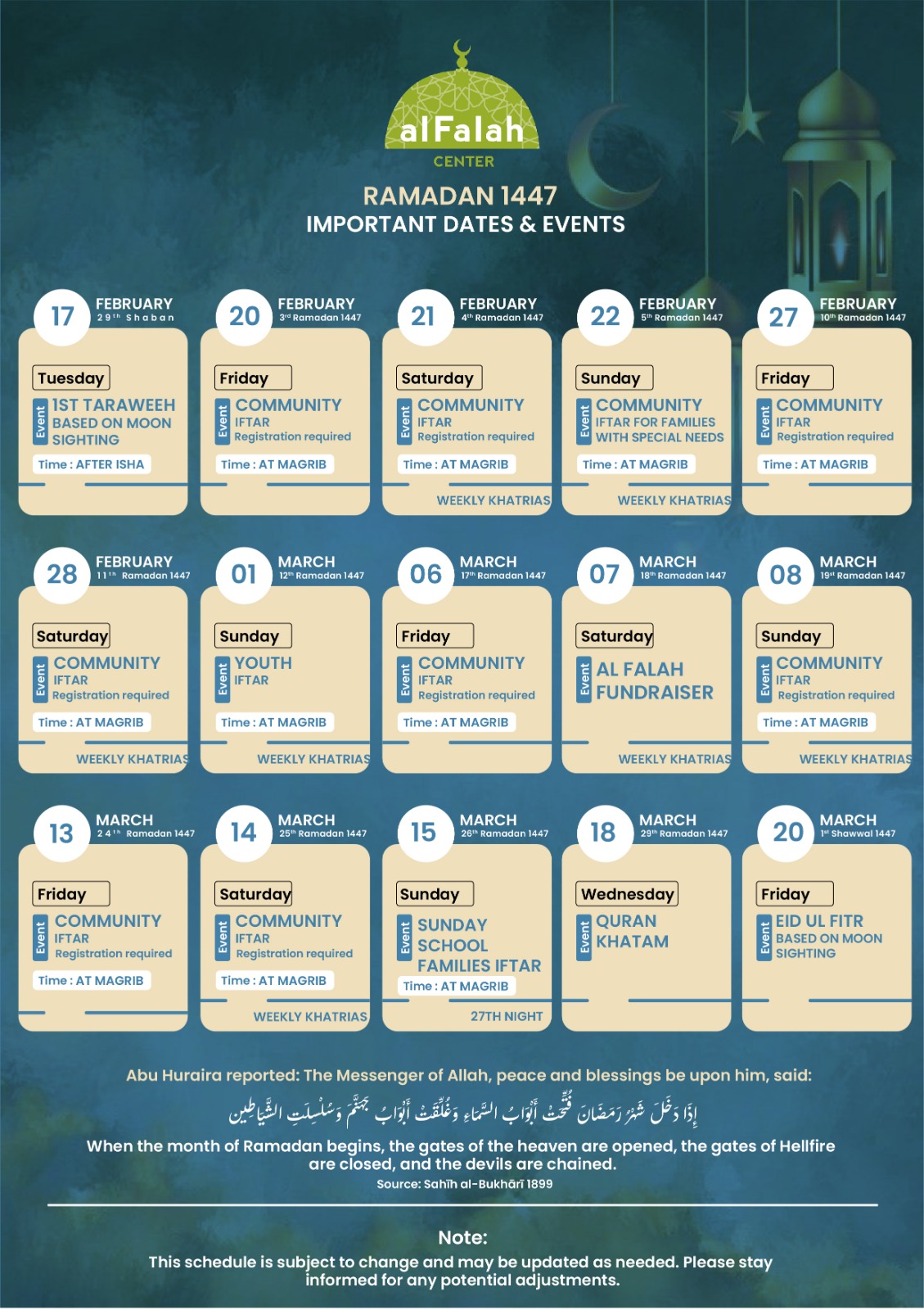
In 2026, Ramadan will begin around the evening of Friday, February 17 through Saturday, March 20, 2025. The exact days are confirmed by the sighting of the new moon at the start of the month.
God says in the Qur’an,
“Ramadan is the month in which the Qur’an was revealed, as guidance for humanity…so whoever of you witnesses the month should fast it.” [2:185]
Muslims therefore celebrate Ramadan by ritually fasting for the entire month in gratitude to God for His final revelation. By restricting the body’s appetites during daylight hours, believers rejuvenate their spirituality, repair their religious conscience, and cultivate their devotion to God. This is the most significant objective of the fast: restoring the centrality of God in our lives.
Muslims observe Ramadan by abstaining from food, drink, smoking, and sexual intimacy—all out of devotion to their Creator. They are also called to practice self-restraint and respond to every situation with patience and kindness. The Prophet Muhammad ﷺ informed us,
“Whoever does not give up lying and acting dishonestly, then [know that] God has no need for this person to give up food and drink (i.e., fasting).” [Sahih al-Bukhari #1903]
In addition to fasting, Muslims also celebrate Ramadan by reciting and studying the Qur’an, performing acts of service, and giving to charity. Many people read the Qur’an cover to cover multiple times over the course of the month. Believers complete their readings individually and in nightly congregations that take place in virtually every mosque on the planet. This is all in emulation of the Prophet Muhammad ﷺ, who would annually rehearse with the archangel Gabriel all that had been revealed to him of the Qur’an.
Muslims fast for the entire month in gratitude to God for His final revelation. By restricting the body’s appetites during daylight hours, believers rejuvenate their spirituality, repair their religious conscience, and cultivate their devotion to God. This is the most significant objective of the fast: restoring the centrality of God in our lives.
Ramadan is a period of practicing extra awareness about all the things that could soil our spirituality and fuel the ego that feeds off our catering to its appetites throughout the year. Vices are always forbidden, but we work with even greater dedication to avoid them and excel in devotion, kindness, patience, and forgiveness in Ramadan. Such inner purity is the intended result of fasting.
Yes. Islam has a merciful and pragmatic legal framework that allows many exceptions to the rules. The categories of people exempted from fasting are an excellent example of that.
Children who haven’t reached the age of puberty are not required to fast, although some like to practice and participate in Ramadan activities. Pregnant women and nursing mothers who struggle to fast, as well as those who are traveling, are allowed to break their fast and make up for the days they missed in Ramadan later on in the year. In addition, women experiencing menses are allowed to rest from the five daily prayers and from fasting.
Muslims maintain the standard five daily prayers, but strive to increase the amount of worship they perform during Ramadan.
In addition to the five daily prayers, many Muslims perform extra nightly prayers called Taraweeh and additional forms of worship such as tahajjud, itikaf, and an increase in reading the Qur’an.
Laylatul Qadr can be translated as The Night of Decree or The Night of Power.
In the context of this holy night, some scholars define “qadr” as “decree” (qadar). In other words, it is the night in which the destiny of each person–their sustenance, lifespan, and other critical matters–is decided and sealed for the coming year.
Other scholars define “qadr” as “power,” indicating the greatness of the night. Similarly, some who interpret “qadr” as “power” do so to bring attention to the fact that righteous deeds performed during this night are far more powerful than they would be on any other night.
The precise night on which Laylatul Qadr occurs has not been mentioned.
The Prophet Muhammad ﷺ said,
“Search for Laylatul Qadr in the odd nights of the last 10 nights of Ramadan.”
There is tremendous wisdom in not knowing exactly when it occurs. As Ibn Qudamah al-Maqdisi (d. 620 AH/1223 CE) writes, “God has concealed this night from the Muslim community (ummah) so that they may strive in seeking it and performing worship throughout the month in the hopes of catching it.
Muslims focus on increasing all of their good actions during the holy month, but particularly increase their generosity through making donations, helping the needy, serving the hungry, and paying a mandatory charity (Zakat al-Fitr) to the poor before the end of Ramadan. This spirit of giving comes from the sympathy we feel for those who have less when we experience hunger and deprivation ourselves, and also from deepening our relationship with God’s word, and understanding the vast mercy and generosity inherent in the nature of God. It is authentically reported that,
“The Prophet ﷺ was the most generous of all the people, and he used to become even more generous in Ramadan.” [Sahih al-Bukhari #3554]
The Fidyah/Kaffarah amount for this year is $15 per day. This amount should be paid for anyone who is unable to fast and cannot make up those fasts. Click the link below to be directed to the Alfalah Center Fidya donation page.
